37
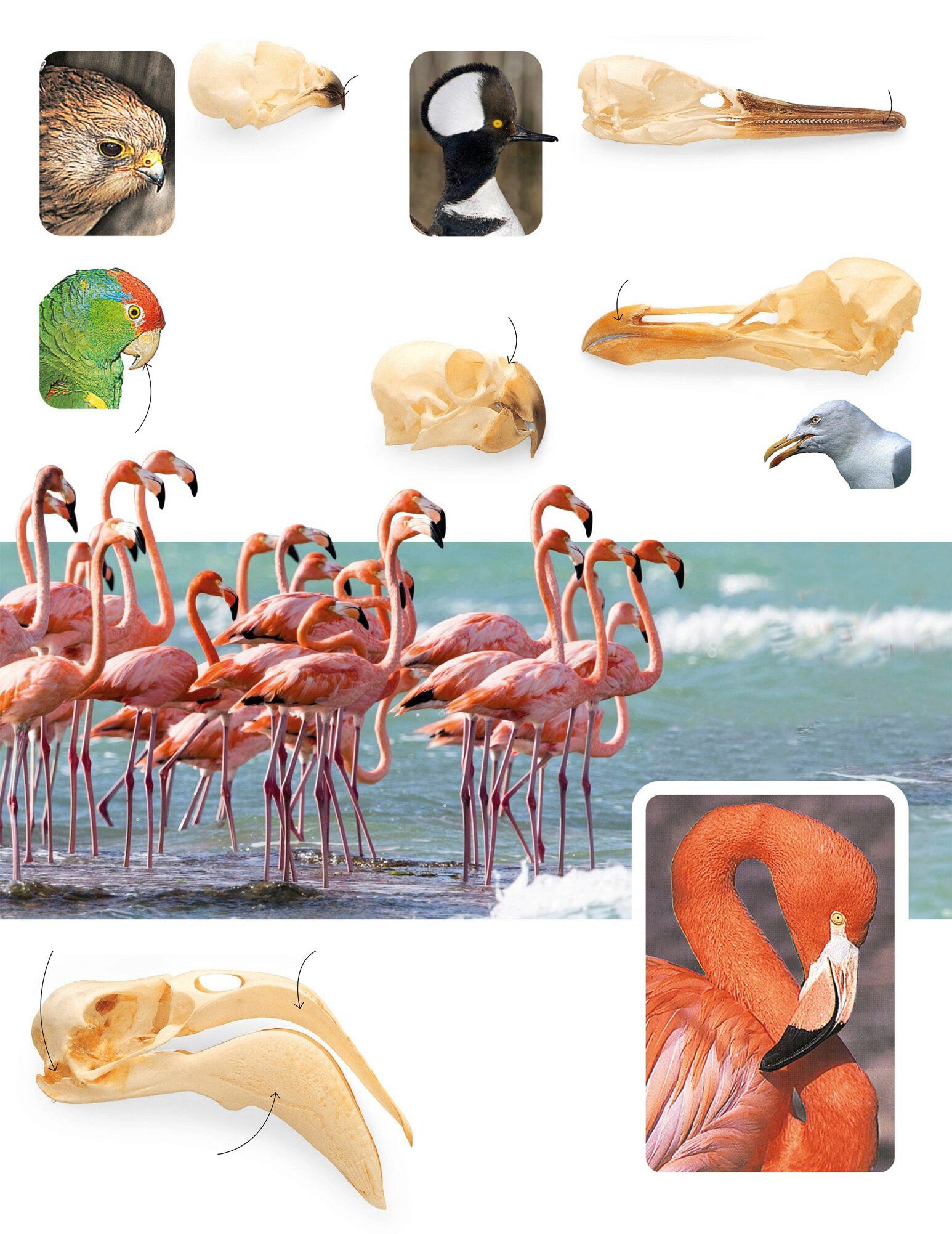
Underwater sieve
The flamingo uses its large
beak to sieve animals and
plants from the water. The
lower bill moves up and
down to pump water
against the top bill, where
a fringe of fine slits traps
the food.
All-purpose beak
Gulls’ long beaks end in a hook.
This enables them to pull
apart their food and hold
prey, like fish along the
length of their beaks.
Saw-like duck bills
Unlike mammals, birds do not have teeth.
However, some birds, such as the merganser,
have saw-like structures on the sides of their
beaks that are used for catching fish.
Fruit-eater’s beak
The parrot uses the hook at the tip of
its beak to extract fruit pulp, while its
jaws are used to crack open
seeds. Parrots also use their
feet to hold and turn their
food while they crack it open.
Meat-eater’s beak
The kestrel’s hooked beak
enables it to pull apart
animals that are too big
to be swallowed whole.
Hook
Hook
The upper bill
has a fringe
to trap food.
Lower bill
Hinge of lower
bill and skull
“Teeth” made from
horny material
Long, hooked beak
Nostril
Kestrel
Merganser
Gull
Parrot